
How Long Does Hair Transplant Last? The Science Behind Permanent Results
When considering a hair transplant, one question rises above all others: “If I invest in this procedure, will it truly last forever?” It’s a fair question given the significant financial and emotional investment involved. The hair restoration industry often promotes “lifetime permanence,” but the reality deserves a more nuanced explanation.
Understanding the science behind hair transplant longevity—including concepts like donor dominance and DHT resistance—empowers patients to set realistic expectations. Hair Restoration Centers, with over 20 years of experience and more than 100,000 patients treated, has witnessed firsthand how transplanted hair behaves over decades. This article provides honest, science-backed information about what “permanent” truly means in the context of hair restoration.
The Short Answer: Yes, Hair Transplants Are Permanent (But Not Unchanging)
Transplanted hair follicles are indeed permanent and genetically resistant to pattern baldness. This fundamental truth has made hair transplantation one of the most reliable solutions for hair loss. However, a critical distinction exists that many providers fail to address: “permanent grafts” and “permanent aesthetic results” are not the same thing.
Transplanted hair will age naturally alongside the rest of the body. It will gray over time, may thin slightly with advanced age, and follows normal hair growth cycles. Meanwhile, native hair surrounding transplanted areas continues to be susceptible to DHT (dihydrotestosterone), the hormone responsible for pattern baldness, and may thin progressively.
Modern hair transplant success rates are well over 90%, often reaching 100%, with graft survival rates typically between 90-95% when performed by skilled surgeons. These statistics demonstrate the procedure’s reliability while acknowledging that outcomes depend heavily on surgical expertise and patient factors.
The Science Behind Hair Transplant Permanence
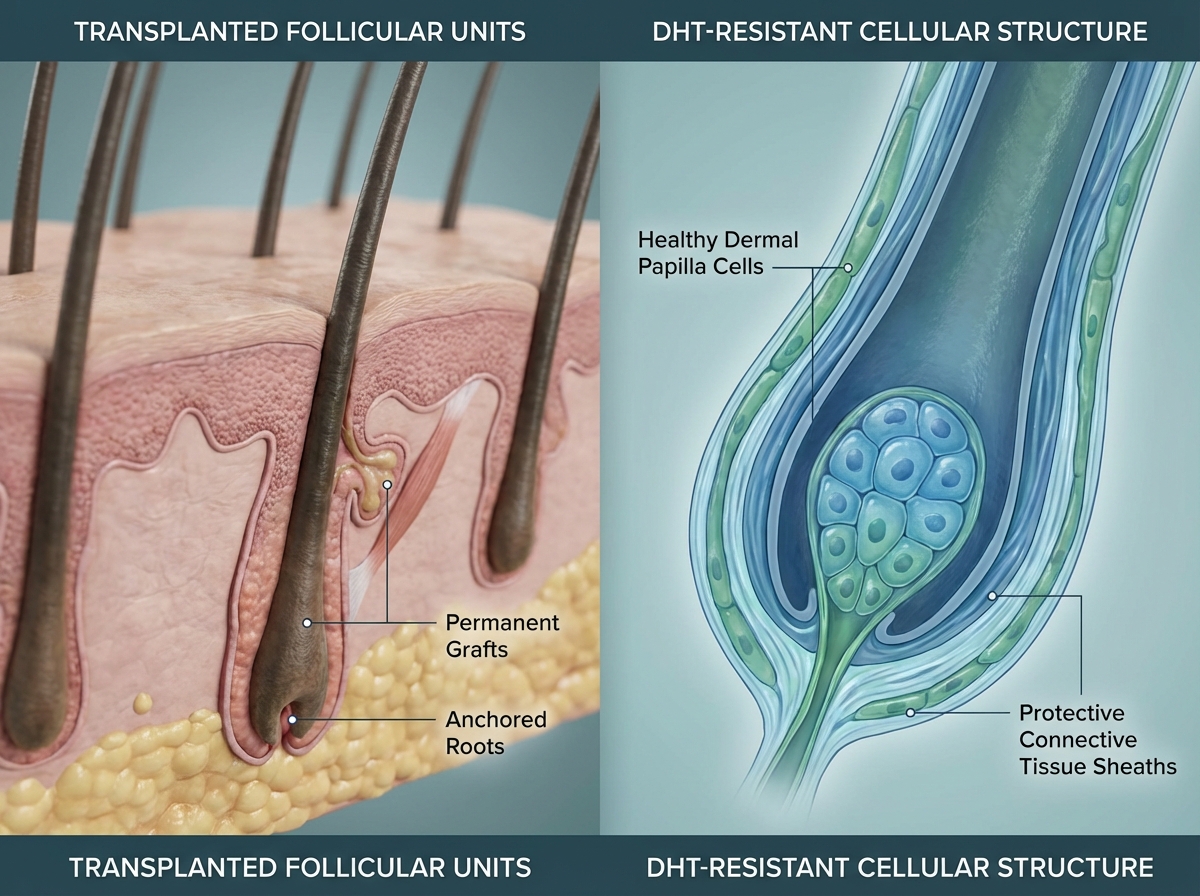
The permanence of hair transplants rests on a scientific principle called “donor dominance,” first established in 1959 by Dr. Norman Orentreich. This concept explains that hair follicles retain their genetic characteristics even when relocated to different areas of the scalp.
Hair follicles harvested from the “safe donor zone”—the occipital and parietal regions at the back and sides of the head—are genetically programmed to resist DHT. When these follicles are transplanted to balding areas, they continue to behave as they would in their original location, remaining resistant to the hormone that causes pattern baldness.
Think of it like transplanting a tree from one garden to another. The tree doesn’t suddenly adopt the soil characteristics of its new location; it continues to produce the same fruit it always has. Similarly, DHT-resistant follicles maintain their protective genetic programming regardless of where they’re placed on the scalp.
What the Research Really Shows: Long-Term Outcomes
Transparency about research findings builds trust and helps patients make informed decisions. A 4-year longitudinal study published in PMC followed 112 FUT patients and found that 55.35% experienced moderate density reduction, 27.67% had slight reduction, 8.92% showed no change, and 8.03% experienced great reduction.
These numbers require context. Density reduction doesn’t mean transplanted hair disappeared—it indicates some natural thinning occurred over time. The positive news is that over 90% of transplanted follicles can survive beyond 10 years with proper care and expert surgery.
Recipient site characteristics, including vascularity and dermal thickness, can influence long-term survival of transplanted hairs. This underscores the importance of choosing an experienced surgical team that understands these variables.
The Complete Timeline: From Surgery to Full Results
Understanding the hair transplant timeline helps patients navigate the waiting period with realistic expectations:
- Weeks 2-4: Initial shedding occurs (shock loss)—this is normal and expected
- Months 3-4: New growth begins to emerge
- Month 6: Approximately 50% of growth becomes visible
- Months 12-15: Full results appear for frontal areas
- Months 18-20: Crown and vertex areas reach final density
The crown area takes longer because of its unique blood supply and growth patterns. Patients should prepare for a 1.5 to 2-year journey before seeing complete results. This waiting period can feel challenging emotionally, but patience yields rewarding outcomes.
Hair Restoration Centers’ experience with over 100,000 patients has refined their ability to set accurate timeline expectations, helping patients understand exactly what to anticipate at each stage.
FUE vs FUT: Does Technique Affect Longevity?
Both FUE (Follicular Unit Extraction) and FUT (Follicular Unit Transplant) produce permanent results when performed correctly. FUE has a success rate of 95-100% and has become increasingly popular due to minimal scarring and faster recovery times.
The technique itself matters less than the surgeon’s skill and how grafts are handled during the procedure. Time out of body (TOB) studies reveal important survival statistics:
- 2 hours: 95% graft survival
- 4 hours: 90% graft survival
- 6 hours: 86% graft survival
- 8 hours: 88% graft survival
These findings emphasize that roughly 1% of grafts are lost per hour outside the body, making surgical efficiency crucial. Hair Restoration Centers offers both FUE and FUT techniques, with board-certified surgeons selecting the most appropriate approach for each patient’s unique situation.
Factors That Influence How Long Results Last
Multiple variables affect the longevity of hair transplant results:
Surgeon Expertise: Proper graft handling, placement depth, and angle significantly impact survival rates and natural appearance.
Donor Hair Quality: Follicles must truly originate from the safe donor zone to ensure DHT resistance.
Patient Genetics: Individual genetic factors influence how native hair responds to continued DHT exposure.
Post-Operative Care: A 2024 study found that only 44% of patients follow medication advice from their surgeons—a statistic that can be detrimental to long-term success.
Maintenance Medications: Finasteride and minoxidil help protect remaining native hair from continued thinning.
Hairline Design: A realistic design that accounts for future aging and potential continued hair loss ensures results remain natural-looking for decades.
What “Permanent” Really Means: Setting Realistic Expectations
Permanent transplanted hair will gray and undergo slight age-related thinning, just like all natural hair. The follicles remain resistant to pattern baldness but follow normal biological aging processes.
The critical consideration is that native hair continues to be susceptible to DHT. The “frame” around transplanted hair may thin over time, potentially affecting the overall aesthetic result. Some patients may benefit from touch-up procedures years or decades later to address continued native hair loss.
This reality doesn’t diminish the value of hair transplants—it simply means maintaining optimal aesthetic results may require ongoing attention to the surrounding native hair.
Maximizing the Longevity of Hair Transplant Results
Patients can take several steps to optimize their long-term outcomes:
- Choose an experienced surgeon: Hair Restoration Centers’ 20+ years of experience provides the expertise necessary for optimal results
- Follow post-operative instructions meticulously: The critical healing period sets the foundation for long-term success
- Use prescribed medications: Finasteride and minoxidil protect native hair from continued loss
- Consider complementary treatments: PRP therapy can support transplanted follicles and overall scalp health
- Attend follow-up appointments: Regular monitoring allows early intervention if concerns arise
- Maintain scalp health: Proper nutrition and gentle hair care practices support healthy hair growth
Will Additional Procedures Be Needed?
Honest discussion about potential future procedures helps patients plan appropriately. Some patients do require touch-ups or additional procedures over time—typically due to continued native hair loss rather than failure of transplanted follicles.
Initial procedure design and careful donor area management affect future options. Surgeons must balance achieving optimal immediate results with preserving donor resources for potential future needs.
Hair Restoration Centers’ 27 convenient locations throughout the United States make follow-up care accessible for patients requiring ongoing monitoring or additional procedures. Additional procedures should be viewed as part of a long-term hair restoration journey rather than a failure of initial surgery.
Hair Restoration Centers: 20+ Years of Proven Long-Term Results
With over 100,000 patients treated, Hair Restoration Centers possesses extensive data on long-term outcomes that informs realistic expectation-setting. Board-certified surgeons with expertise in both FUE and FUT techniques ensure patients receive the most appropriate treatment for their individual needs.
Two decades of experience provides invaluable insight into how transplanted hair behaves over time. The company’s 27 U.S. locations offer a significant advantage over overseas options, which often lack the infrastructure for long-term follow-up and care.
Conclusion
Hair transplants are indeed permanent due to donor dominance and DHT resistance—the science firmly supports this conclusion. However, “permanent” means resistant to pattern baldness, not immune to natural aging processes. Transplanted hair will gray and may thin slightly over time, while surrounding native hair continues to be susceptible to DHT.
The 1.5 to 2-year maturation timeline requires patience, but the results are lasting. Some patients may need touch-up procedures to address continued native hair loss, and this transparency builds trust rather than diminishing it.
With proper surgeon selection, appropriate technique, and diligent aftercare, transplanted hair can last for decades, providing natural-looking results that age gracefully alongside the patient.
Take the First Step Toward Permanent Hair Restoration
Those ready to explore hair restoration options can schedule a free consultation at one of Hair Restoration Centers’ 27 convenient locations. The process is straightforward: submit photos for evaluation, speak with a patient advisor within 24 hours, and schedule a procedure with a board-certified surgeon.
With over 20 years of experience and more than 100,000 successful patient outcomes, Hair Restoration Centers provides realistic expectations backed by proven results. Contact them at (855) 976-3638 or visit affordablehairtransplants.com to begin the journey.
Understanding how long hair transplants last begins with understanding each patient’s unique situation—and that understanding starts with a personalized consultation.