
FUT vs FUE Hair Transplant: Which Method Is Right for You in 2026?
Introduction
Choosing between FUT and FUE hair transplant methods represents one of the most significant decisions individuals face when considering surgical hair restoration. Both techniques have evolved considerably over the years, offering proven, effective solutions for those experiencing hair loss.
Both FUT (Follicular Unit Transplantation) and FUE (Follicular Unit Extraction) deliver comparable success rates, with graft survival ranging from 85-95%. While FUE has become increasingly popular in recent years, FUT remains a valuable option for specific situations requiring maximum graft yield.
Neither method is universally superior. The right choice depends entirely on individual circumstances, goals, lifestyle preferences, and the extent of hair loss. This comprehensive comparison examines the key differences between these two techniques, covering procedure specifics, recovery expectations, scarring outcomes, cost considerations, and candidacy factors to help patients make informed decisions.
Understanding FUT (Follicular Unit Transplantation)
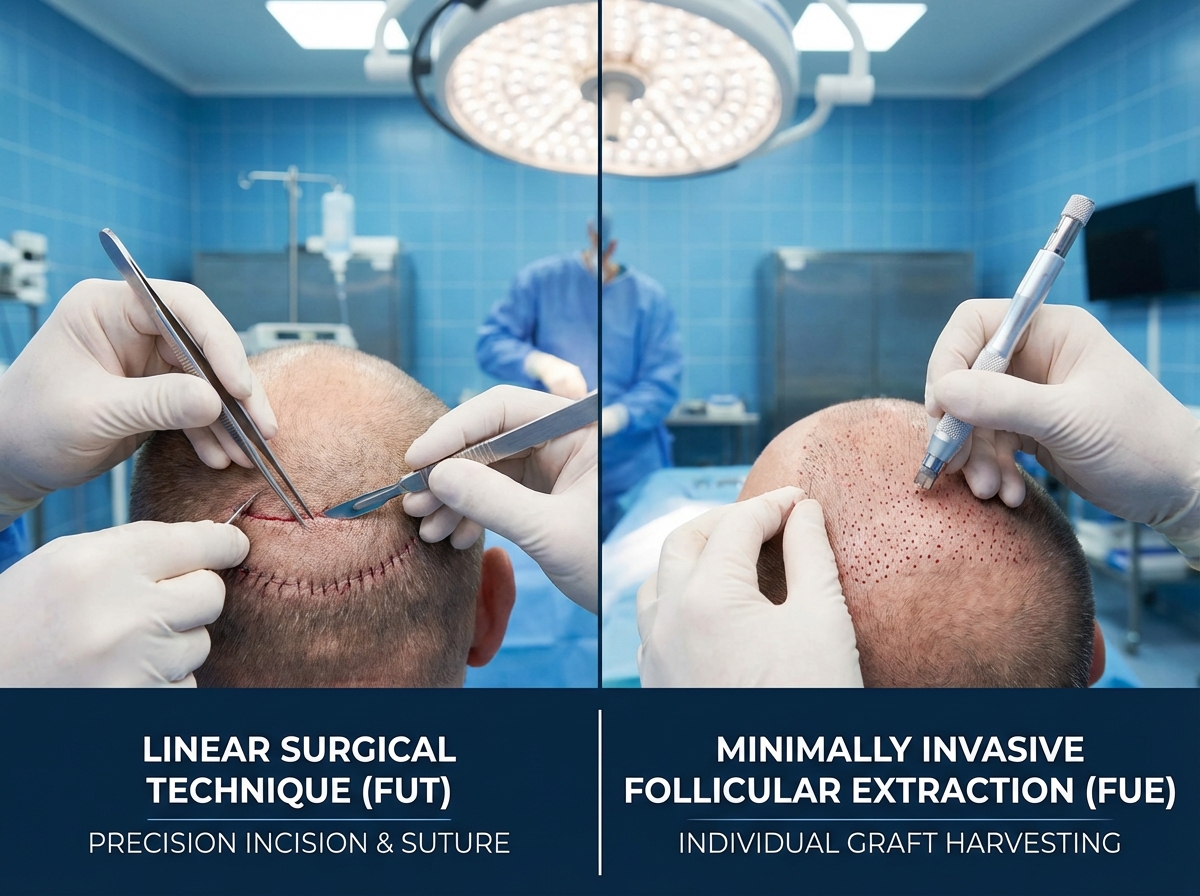
FUT, commonly known as the strip method, involves removing a section of scalp tissue from the donor area—typically the back of the head where hair is genetically resistant to balding. This strip is then carefully processed using microscopic dissection to divide it into individual follicular units, each containing one to four hairs.
One of FUT’s primary advantages lies in its harvesting efficiency. The technique can extract a high percentage of follicles from the selected donor area, maximizing the total graft yield available in a single session. This makes FUT particularly valuable for patients with extensive hair loss who require significant coverage.
Another notable benefit is that FUT does not require head shaving. Patients who need discretion during their recovery period—whether for professional or personal reasons—often prefer this approach since the donor area can be concealed by surrounding hair immediately after the procedure.
Many surgeons consider FUT an excellent option for achieving maximum fullness and density. The microscopic dissection process allows for precise separation of follicular units, potentially resulting in higher-quality grafts with intact surrounding tissue.
The trade-off is a linear scar at the donor site. However, this scar can typically be concealed with hair at least half an inch long, making it invisible under normal circumstances for most patients.
Understanding FUE (Follicular Unit Extraction)
FUE takes a different approach by extracting individual follicular units directly from the scalp using specialized punch tools. Rather than removing a strip of tissue, the surgeon harvests grafts one by one, leaving tiny circular marks instead of a linear scar.
This extraction method harvests grafts from a wider area of the donor region to maintain the donor area’s natural appearance and density. Modern FUE clinics have significantly improved their capabilities, now achieving average graft counts of 2,000-3,000 per session—comparable to FUT’s typical yield.
The minimally invasive nature of FUE appeals to many patients. The scattered dot scars are far less visible than a linear scar, even when hair is worn very short or shaved. This flexibility makes FUE particularly attractive for individuals with active lifestyles or those who prefer shorter hairstyles.
Technological advancements have further enhanced FUE outcomes. Robotic systems like the ARTAS have improved graft quality and consistency, reducing the historical gap between FUE and FUT in terms of follicle viability. These innovations have made FUE an increasingly competitive option for a broader range of candidates.
Key Differences Between FUT and FUE
Understanding the specific differences between these techniques helps patients identify which approach aligns best with their needs and expectations.
Scarring and Aesthetic Outcomes
The most visible difference between FUT and FUE lies in scarring patterns. FUT produces a linear scar that runs horizontally across the donor area, while FUE creates multiple tiny dot scars scattered throughout the extraction zone.
Research indicates that hypertrophic scarring after FUT occurs in up to 15.1% of cases, representing the most common donor-site complication according to recent clinical reviews. However, when performed by experienced surgeons using proper closure techniques, most FUT scars heal as thin lines easily hidden by longer hair.
FUE’s scattered scarring pattern offers greater hairstyle flexibility post-procedure. Patients can wear their hair in buzz cuts or very short styles without visible evidence of the transplant. This aesthetic advantage drives much of FUE’s popularity among younger patients and those in image-conscious professions.
Both techniques produce natural-looking results in the recipient area when performed by skilled surgeons. The final aesthetic outcome depends more on the surgeon’s artistry in designing the hairline and placing grafts than on the extraction method chosen.
Recovery Time and Post-Operative Experience
Recovery timelines differ notably between the two procedures. FUE patients typically resume normal activities within 5-7 days, while FUT recovery generally requires 10-15 days before returning to regular routines.
FUT patients often experience more post-operative discomfort due to the linear incision, which requires sutures or staples. The donor area may feel tight or tender for several weeks as the wound heals. FUE patients, by contrast, usually report minimal discomfort since no large incision is made.
Activity restrictions also vary. FUE allows a quicker return to strenuous activities, including exercise and sports, making it preferable for athletes or fitness enthusiasts. FUT patients must avoid activities that could stress the healing incision for a longer period.
Overall complication rates for both methods remain low—between 1.2% and 4.7%—when performed by qualified providers. Serious complications are rare with either technique when proper protocols are followed.
Graft Yield and Session Capacity
Average graft counts have converged significantly in recent years. Both FUT and FUE sessions typically yield around 2,000-3,000 grafts per session. However, for patients requiring more than 3,000 grafts in a single session, FUT may still offer advantages due to its more efficient harvesting method.
FUT’s microscopic dissection provides a potential advantage in graft quality. The careful separation of follicular units under magnification can preserve more of the protective tissue surrounding each graft. FUE carries a slightly higher risk of transection—damage to follicles during extraction—though modern techniques have minimized this concern.
Both methods deliver excellent results when performed properly, with survival rates in the 85-95% range.
Cost Considerations
The cost gap between FUT and FUE has narrowed considerably in 2026. FUE is no longer substantially more expensive than FUT at most reputable clinics, though FUT typically remains slightly more cost-effective on a per-graft basis due to faster harvesting times.
The hair transplant industry continues to experience significant growth, with increased competition helping moderate pricing across both techniques. Total procedure cost ultimately depends more on the number of grafts needed than on the technique selected.
Patients should avoid choosing a method based solely on cost. Candidacy factors and personal goals should drive the decision, with cost serving as a secondary consideration.
Who Is the Ideal Candidate for Each Method?
Best Candidates for FUT
FUT may be the optimal choice for patients who:
- Have extensive hair loss requiring maximum graft yield in a single session
- Wear their hair longer and can easily conceal a linear scar
- Cannot shave their head for professional or personal reasons
- Seek a cost-effective option per graft
- Have tight scalps where FUE extraction would prove difficult
- Prioritize maximum fullness and density
Best Candidates for FUE
FUE typically suits patients who:
- Prefer to wear their hair very short or shaved
- Are athletes or active individuals needing quick return to strenuous activities
- Have a history of poor scarring or keloid formation
- Have tight scalps where strip removal would be challenging
- Seek minimal visible scarring and faster recovery
- Are undergoing a second procedure after previous FUT
- Require facial hair transplants for eyebrows, beard, or mustache
Long-Term Considerations and Future Procedures
Planning for the future matters significantly in hair restoration. Research indicates that 30-40% of patients undergo a second hair transplant due to progressive hair loss or desire for increased density.
Many surgeons recommend combination approaches—performing FUT first for maximum initial yield, then using FUE for subsequent sessions. This strategy maximizes the total available grafts over a patient’s lifetime while preserving options.
FUT may limit future FUE options in the previously harvested strip area, while FUE preserves more flexibility for subsequent procedures. Working with experienced surgeons who understand both techniques ensures proper donor area management for long-term success.
Making the Decision: Factors to Consider
Key decision factors include lifestyle, hairstyle preferences, extent of hair loss, available recovery time, and budget. Both techniques deliver comparable success rates and produce excellent, natural-looking results when performed by skilled surgeons.
Patients should consult with board-certified surgeons who offer both FUT and FUE and can provide personalized recommendations based on individual circumstances rather than personal preference. The best surgeons have expertise in both procedures and will recommend the most appropriate technique for each patient’s unique situation.
Why Choose Hair Restoration Centers for the Procedure
Hair Restoration Centers offers both FUT and FUE techniques at 27 convenient U.S. locations. With over 20 years of experience and more than 100,000 patients successfully treated, the practice provides access to board-certified surgeons who are experts in both methods.
The comprehensive consultation process includes photo evaluation and dedicated patient advisors who help individuals understand their options. U.S.-based procedures with experienced, credentialed providers offer safety advantages and accountability that international alternatives may lack.
Conclusion
Neither FUT nor FUE is universally superior—both represent excellent techniques with different clinical indications. FUE offers faster recovery and minimal visible scarring, while FUT provides efficient graft harvesting and cost-effectiveness for extensive hair loss cases.
The right choice depends on individual factors including the extent of hair loss, lifestyle considerations, hairstyle preferences, and available recovery time. With proper technique and experienced providers, both methods deliver natural-looking, permanent results that can transform patients’ confidence and appearance.
Take the Next Step Toward Hair Restoration
Individuals considering hair restoration are encouraged to schedule a free consultation at Hair Restoration Centers. The process is straightforward: submit photos for evaluation, speak with a patient advisor within 24 hours, and schedule an appointment with a surgeon.
To begin the hair restoration journey, call (855) 976-3638 or visit the website. The consultation provides personalized recommendations on whether FUT or FUE best suits each patient’s unique situation. The experienced team answers all questions and addresses concerns about both techniques.
Early intervention often provides the best results for hair restoration, making now the ideal time to explore available options.